
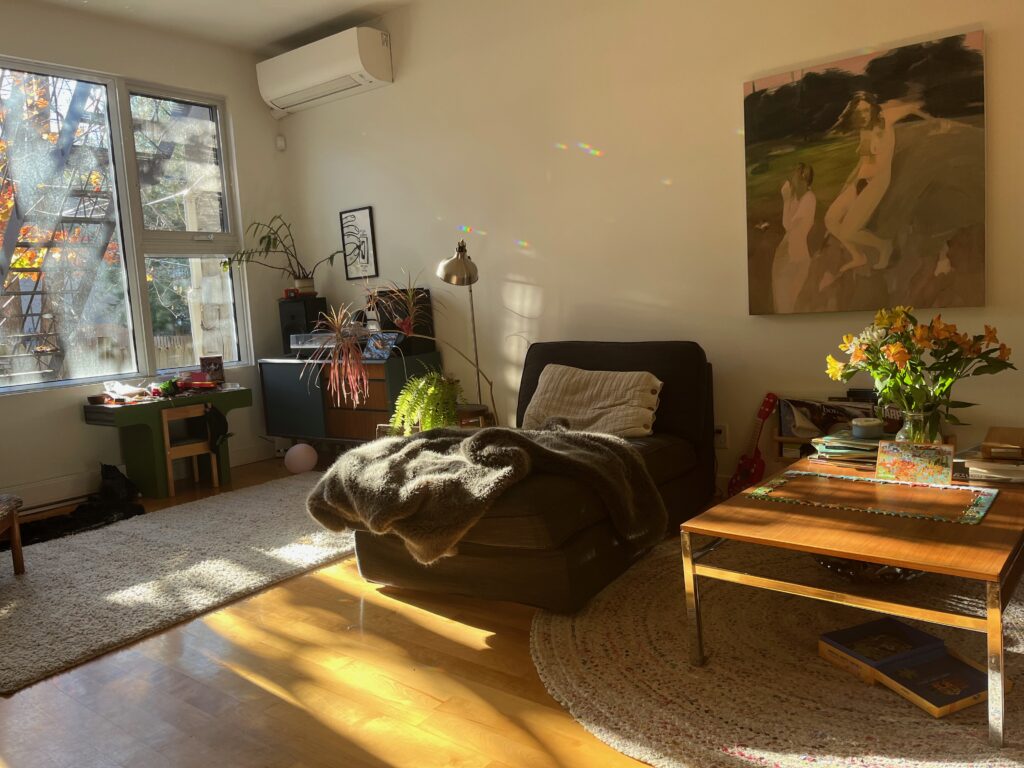
Transform your space
I’m Karen Messer. I am a researcher and consultant. I explore how our spaces influence our day-to-day lives, while working with individual and family to transform their homes into supportive, comfortable and healthy environments.
I use my knowledge of sensory design, coaching, and organization to create happier homes!
About me
I love organizing. I love seeing how rooms can be transformed after re-arranging their contents. I believe our surroundings affect us at a deep level, making them an important part of our day-to-day wellbeing.
The way I work is informed by my PhD in Relational Space & Organizations, but my love of space goes back as long as I can remember. For me, decluttering doesn’t mean minimalism and I don’t believe you need to spend a lot of money to have a beautiful, supportive, space. It’s about taking the time to discover what works for you.

In many ways homes are a witness and companions to our daily life. They store our memories through objects, scents, and sounds. Like family members or close friends, they are participants in our lives. And like any relationship, the connections with our spaces need tending.Working with our space is less about perfect decor and more about making sure they support us and feel good.


Things to consider
- Do you have things you love to do, but don’t do them because the space makes it hard?
- Do you have an aging parent who needs help reducing their stuff?
- Do you feel like your space is never-ending chaos?
- Are you making some personal changes and want your home to support you in that journey?
- Are you moving (or just moved) and feel overwhelmed?
- Do you have ADHD and find it difficult to keep track of your material possessions?
- Do you have kids who have taken over the entire house with their things?
- Do you want your space to feel different but don’t know how to start?
How to Work with Space
How to Work with Space
Spatial Knowledge in Organizations and Research Practice
Palgrave Studies in Business, Arts and Humanities series. Series Editors Samantha Parsley & Steven Taylor
How to Work with Space draws on relational concepts of physical space as a way of understanding and framing organizational experience. Space is framed as something central and entangled, freeing it from objective, external binaries by positioning it alongside the social, inter-subjective sphere. This cultivates an emplaced, relational, and more-than-human understanding of the emotional, sensory, and atmospheric experiences that happen at work.
By tapping into personal experience, spatial theories become intwined with everyday spaces at home and at the office. This subtly shifts the discussion toward what is possible when space is interwoven into day-to-day actions. The book culminates with a case study exploring the aesthetic, sensory, and embodied relationships between a not-for-profit, youth health organization and their office encounters during a significant relocation. By highlighting before and after moments between the staff and their offices, a rich picture of their experience emerges through spatial memory, sensory knowledge, and aesthetic understanding.
Click here for more information or to buy the book. You can also request it through your local or school library.

What people are saying:
Get in touch!
© 2025 A Fine Messer · All Rights Reserved
Privacy | Terms & Disclaimer